




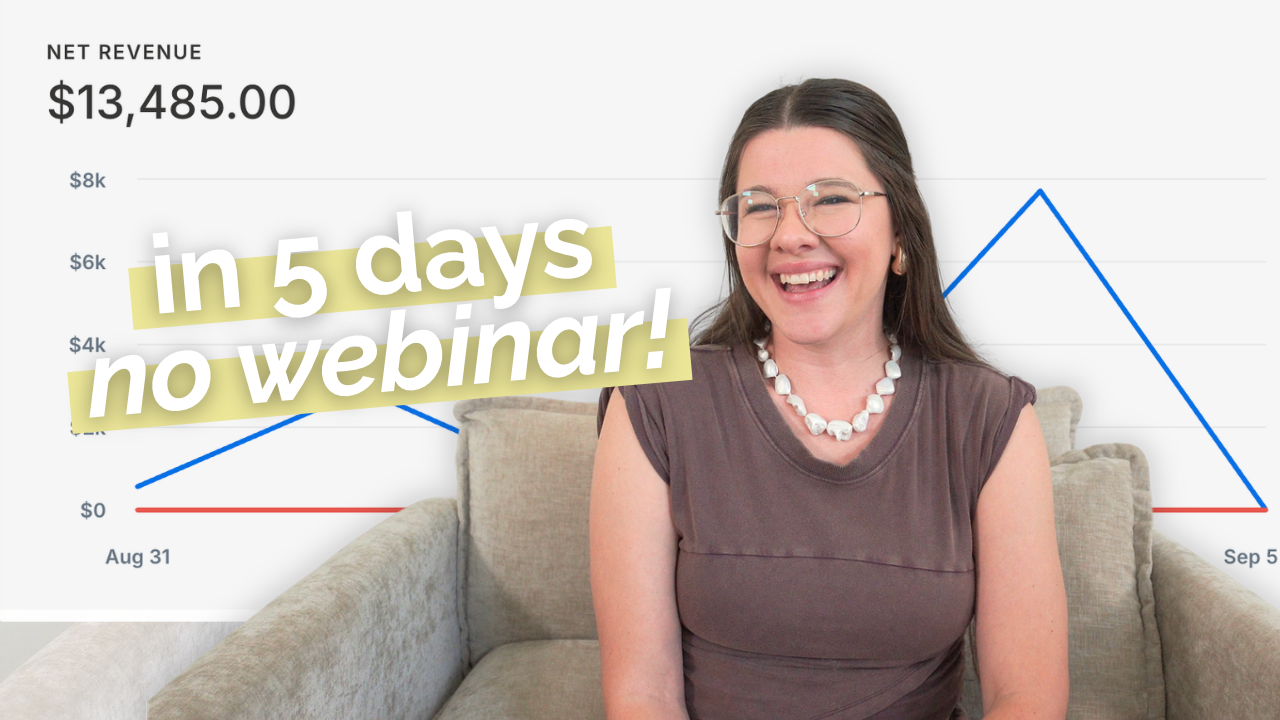

A recent five-day launch brought in $14,686. I ran it without a live challenge, without a live webinar, and without building anything new from scratch. I sold to an audience I had already pitched this course to over and over.
Here is how the launch worked: what I sold, who I sold it to, the three channels I used, and every number from the week.
LINKS MENTIONED:
▸ Watch my free YouTube class
▸ ManyChat (Instagram DM automations, the tool behind my story replies)
▸ Hyros (Ad Tracking & Attribution Software)
▸ YouTube for Business
The offer and why I changed it
YouTube for Business is my biggest program, and it is where I want everyone in my world to end up. I launched it in January 2024 as a lower-ticket offer. For about the past year I sold it at $597, the lowest price anyone saw from me, whether it was Black Friday or inside one of my webinars.
I wanted to raise that price for one reason: ads. I wanted to run ads profitably to people who had never heard of me. At $597, my conversion rate and price point did not leave enough room to make ads worth my time, so the price had to go up.
I was also adding new modules and a brand new AI component, my Claude YouTube team. That is the set of Claude skills I trained and use for my own YouTube content, packaged so students can upload them into their own accounts. A price increase plus a real upgrade gave me a clear reason to give my audience one last chance to join before the price changed.
Two offers, two segments, five days
I ran two offers side by side from Monday through Friday, each aimed at a different slice of my list.
- People who did not own YouTube for Business: a last chance at $597 before the price went up. At checkout, they could add the Claude YouTube team.
- People who already owned YouTube for Business: a one-time offer to add the Claude YouTube team without buying the course again.
I do not sell the Claude YouTube team on its own, and I do not plan to. You need YouTube for Business for it to be useful. Existing students still wanted a way in, so the back-end offer gave them one.
About 350 students are inside YouTube for Business, and roughly 290 of them are active on my email list. The other segment was everyone else on my list, more than 20,000 people.
The marketing: three channels
When I plan a launch, I ask how I can reach the right people in my audience as effectively as possible. Three channels did the work.
1. Email
Email is always my number one channel. I use social media and YouTube to get people onto my email list or into a webinar, and I sell to them by email. Some of my launches have taken only a handful of emails because email converts that well.
Both segments got emails every day, Monday through Friday, with two or three on Friday. That added up to seven or eight emails per segment. The week before, my regular newsletters carried hints in the PS that the price was about to change, so nobody was surprised when the real deadline arrived.
2. Instagram Stories
I created a story for every day of the week ahead of time, and a team member posted them for me. Each one linked straight to YouTube for Business. Having them scheduled meant I never had to decide on Wednesday whether to keep posting because sales were slow.
I also built a ManyChat automation. When someone replied to a story, they received a link to the course. A few minutes later they got a voice message from me, recorded in my phone’s voice memo app, checking in and offering to answer questions.
A paid-offer pitch on stories gets fewer replies than a freebie. A freebie can bring in 300 replies. The people who reply to a paid offer have much higher intent, and plenty of them did.
3. Meta ads to a warm audience
I ran ads only to my hottest people: my email list, past customers, and people who follow me on Instagram. All of them already know me. The ads went straight to the YouTube for Business checkout, with the last-chance messaging and a countdown timer. Buyers could choose pay in full or a split payment.
The numbers
YouTube for Business (last-chance price)
- 3 Split payments of $227: 1 sale for $681 in revenue
- Pay in full at $597: 9 sales for $5,373 in revenue
- Order bumps and upsells (combined): $1,686 in revenue
- Total: $7,740 in revenue
Claude YouTube team (existing students)
- Regular price, $297: 18 sales for $5,346 in revenue
- Workshop-ticket price, $200: 8 sales for $1,600 in revenue
- Total: 26 sales for $6,946 in revenue
The $200 price had a reason behind it. I had recently run a video editing workshop that was part of the Claude YouTube team. It was open to anyone, and I used it to get live feedback and questions before turning it into a product. Existing students who had paid $97 for that workshop got a special link to apply that $97 toward the team.
Launch total: $14,686. Almost all of it was cash collected during the week, because only one buyer chose a payment plan.
What the ads did
Meta reported a 14.7 ROAS: $267 spent and $3,937 attributed. I also use Hyros, which tracks more accurately what came from ads versus my organic content. Counting only people who clicked an ad and bought right after, Hyros showed about $564 in revenue on the same $267, roughly 2X.
Some buyers saw my ads, clicked, and then bought later through an email or a story, so the last click belongs to another channel. Others saw several ads and never clicked at all. The ads were one more touch point in a week full of them, and I will gladly spend $267 to make over $500 on top of everything else.
What I learned
Small segments can be your best audience
I pitched YouTube for Business to more than 20,000 people and brought in $7,740. I pitched the Claude YouTube team to fewer than 300 people and brought in $6,946. People who already bought from you are the best audience for the next thing, even when that group is tiny.
A big update or price increase is a reason to pitch your warm audience
It would have been easy to skip this launch. It was the end of summer, which tends to be slow for YouTube products, and I had pitched the course a month earlier. People get ready at different times. Some want it now, and some know they will want it in three months and would rather pay the lower price today. If you plan a price increase or a major update, tell your audience first and give them the chance to join.
Keep showing up after day one
The Claude YouTube team sales trickled in all week. YouTube for Business was different: most of those sales came on the final day. By Thursday I had two or three and was telling a friend I did not know how many more would come.
I kept going. I wrote fresh angles for my emails and stories instead of only repurposing old ones, I left the ads on, and I posted stories every day. If I had announced the deadline on Monday and gone quiet, those last-day sales would not have happened.
Prepare before launch week
I wrote my emails and created my stories before the week started. When sales are slow on Wednesday, it is tempting to decide that stories are not working and stop. With everything prepared, I could change an idea when I felt inspired or post more, and I never had to start from zero in the middle of the week.
I learned the same lesson in February 2020, when I ran my first course launch. I had my emails written, a challenge planned, and YouTube and Instagram content ready ahead of time. I made that content while I was excited, before the launch started, so my energy at the halfway point did not decide how it showed up.
Want a YouTube system behind your next launch?
My free YouTube class shows how I use YouTube to bring in leads and sales. Watch the free class here.