





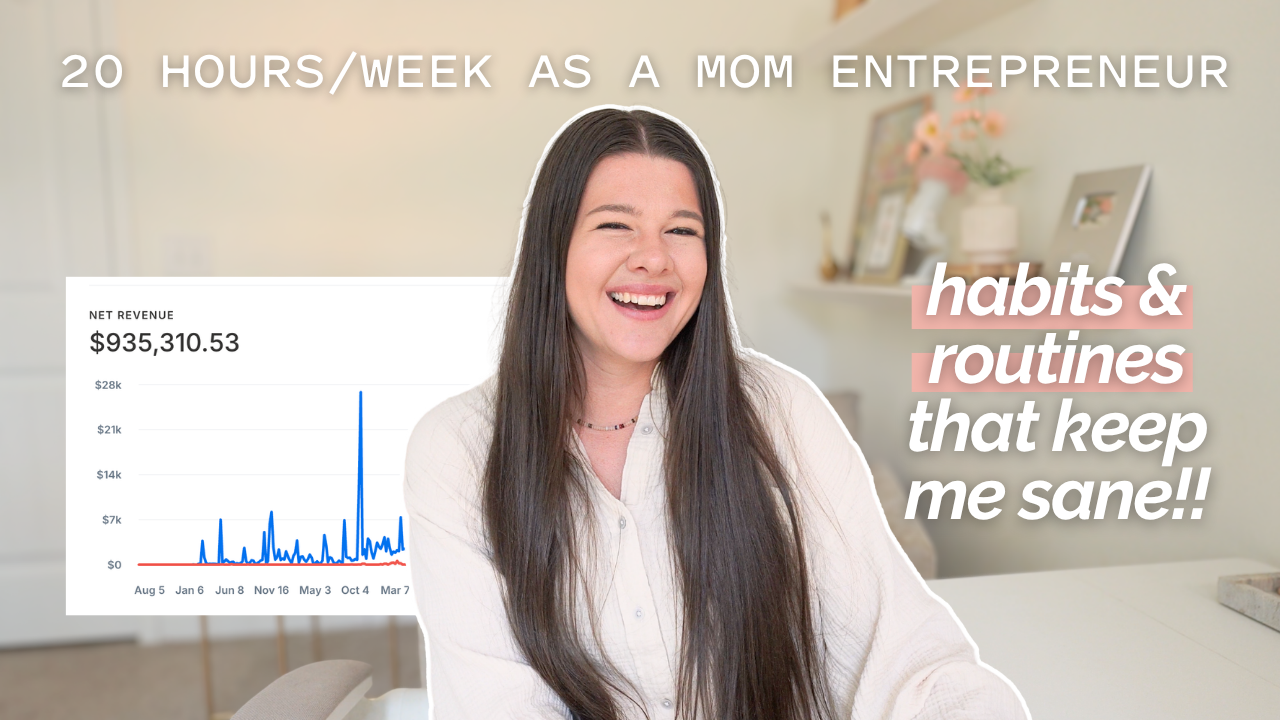

I don’t wake up to an alarm. I work about 20 hours a week. And my business has brought in multi-six figures for years now.
That is not a humble brag. It is the whole point. Because somewhere along the way, we all absorbed the idea that a “real” business means 60-hour weeks, a packed calendar, and answering emails at 11pm. I built the opposite on purpose, as a work-from-home mom of three, and it has held up for years.
Below are the 10 habits and routines that make it work. None of them are about doing more. They are about being intentional with less.
LINKS MENTIONED:
- Download my free passive income guide
- My weekly planning Trello template
- Toggl (the free time-tracking tool I use)
- How to use Toggl YouTube video
- What I’m Doing Right Now With Content, Social Media, & Ads to Market My Courses in 2026 YouTube video
Can you really run a 6-figure business part-time?
Yes, you can run a 6-figure business part-time, and I have done it for multiple years on about 20 hours a week while raising three kids at home. The key is not squeezing more hours out of your day. It is deciding which few activities actually grow revenue, protecting the time to do them well, and cutting almost everything else.
That shift is what the rest of this post is about. Here is how I structure my days, my weeks, and my energy.
1. Slow mornings (sleep is a strategy, not a sacrifice)
I love a slow morning. My husband and I take a couple of hours as a family before any work starts. Breakfast, coffee, kids, no rushing. We are not early risers, and I do not set an alarm. I wake up to one of my kids or to my own body deciding it is time.
I feel dramatically better the entire day when I start it slow. Rest is not the thing you earn after the work. It is what makes the work sharp.
2. Build a work routine around your season of motherhood
The best routine is the one that fits the season you are actually in, not the one a productivity guru sells you. When my twins were newborns and I was nursing around the clock, I could not work a normal day, so I stitched together an hour here and an hour there. For the first eight months, I barely worked at all, until my husband left his 9-to-5 so I could put more time in.
When I had my third, I went back to short windows between feedings. Then, as my kids grew out of the toddler and nursing stage, I shifted into three focused work days a week. The routine changed every season. The willingness to redesign it is the actual habit.
3. Protect your deep work (and do the light stuff on the go)
Not all work is created equal, so I split it in two. Deep work is anything that needs my full brain: filming videos, writing launches, building ads. That stays at my desk, in my office, on my three focused days. Light work like posting an Instagram story takes ten minutes and almost no brainpower, so I do it in the car or in the pockets between everything else.
Having a dedicated office space helps more than I expected. It gives me a clear “on” switch, and it gives my kids a boundary too. When mom is in the office, mom is working. When she walks out, she is done.
4. Plan your week before it starts
Walk into your workday knowing exactly what you are doing, or the day will decide for you. Every week, usually the Friday before or the Monday of, I map out my three big work days. When I sit down already knowing the project in front of me, I dive in. When I do not, I “check” Instagram, then email, then messages, and suddenly an hour is gone with zero deep work done.
I have used the same weekly planning template in Trello for years. Each week is a list, each day has its tasks, and my brain stays organized instead of holding everything at once.
5. Keep one catch-all admin day
Batch every small, shallow task into a single day so it stops leaking into the rest of your week. Mine is Monday. Anything that takes under an hour, is not urgent, and can wait, gets added to the Monday list: send that link, upload that headshot, set up that account, pay those taxes.
Here is why it matters. Every time your brain drops out of deep work to knock out a tiny task, it pays a switching cost. Pile the little things into one day, and your other work days stay clear for one or two real projects, like writing a month of emails or filming a product.
6. Track your time with Toggl
You do not actually know where your time goes until you track it, and Toggl makes it obvious fast. It is a free tool I have used for years. I clock in like an employee of my own business, even for a two-minute Instagram post in the car.
After a week or two, the pattern is impossible to ignore. You see exactly how many hours are going to things that do not move the needle. That awareness is the setup for the next habit.
7. Cut the fluff
Once you can see where your hours go, start saying no to everything that does not grow the business. I turn down collaborations, summits, and bundles constantly. Not because they are bad, but because my best energy belongs on the few things that actually drive revenue.
For me, that is marketing. It gets about 90% of my time, and I only know that because I track it. You cannot cut the fluff until you can see the fluff.
8. Batch, automate, or delegate everything else
For any task that still matters but eats too much time, run it through three options: batch it, automate it, or delegate it. Instead of writing one email a week, I write four or five in one sitting. Instead of doing repetitive work by hand, I automate it with workflows and AI. And anything that does not truly need me, or that someone else could do better, I hand off.
Important tasks do not all have to be done the slow way, and they do not all have to be done by you.
9. Review your numbers (daily for ads, weekly for the business)
Data should drive your decisions, not gut feelings or a busy-feeling day. I check the numbers that matter: how many leads I need to hit my sales goals, my cost to acquire a customer, what people spend upfront, lifetime value, plus platform stats like views and followers.
I review overall business numbers weekly at a minimum. Ads I watch daily, because they move fast and I want to catch a problem before it spirals. Knowing your numbers is what turns guessing into strategy.
10. Prioritize real time off
Real time off means your brain is off too, not just your laptop. I build it into every single week, plus trips and vacations where I am genuinely unplugged. It feels counterintuitive when you are ambitious, but stepping away is what makes me a better business owner than staying permanently switched on.
This only works because the other nine habits are in place. Focused work and solid systems are what let you walk away without everything falling apart.
The real takeaway
Six figures does not require 60-hour weeks. It requires clarity about what actually matters, systems that protect your time, and the discipline to guard the hours you do have.
These habits are not about cramming more into your day. They are about building a business that funds your life instead of consuming it. Start with one. Track your time this week, or block out a single admin day, and let the momentum build from there.
Want the system that lets my business keep selling while I am offline? Grab my free passive income guide and see how the marketing side runs behind the scenes.