




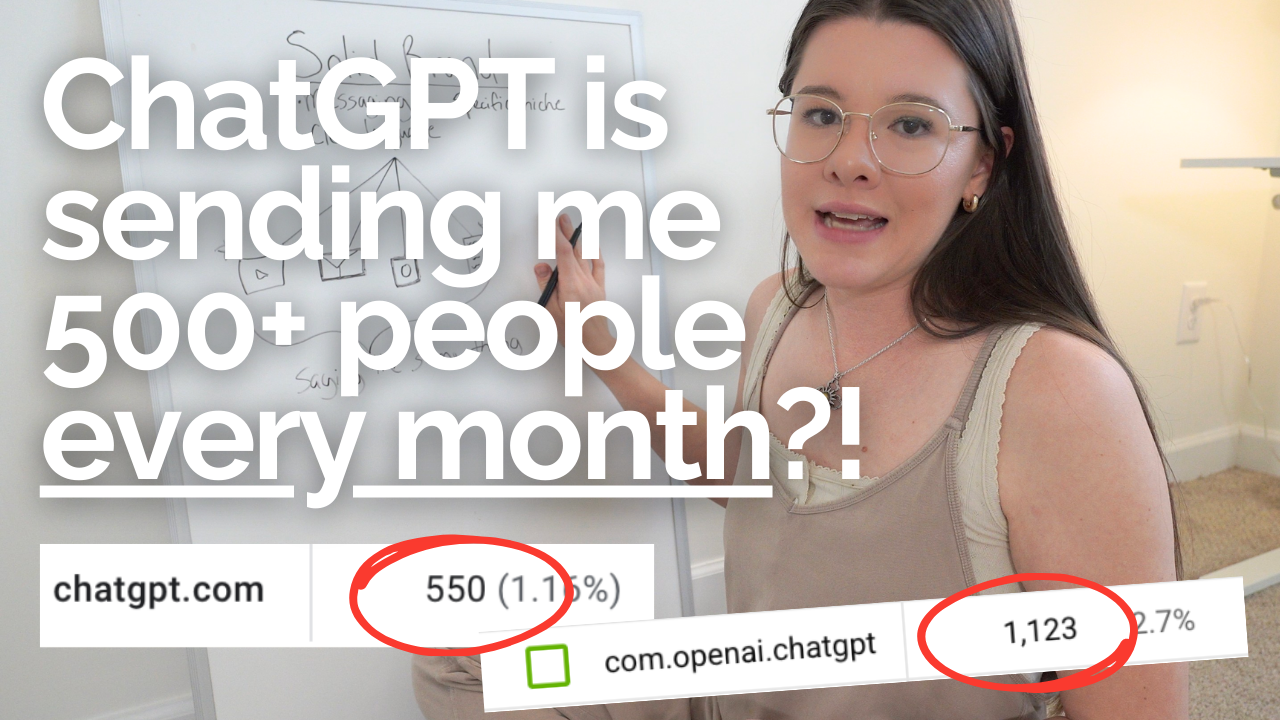

In this post, I’m sharing something that completely blew my mind recently – ChatGPT has been sending hundreds of people to my website every month… and it’s only growing. I’ll break down exactly how this is happening and what you can do to show up in AI tools like ChatGPT too.
Whether you’re a business owner, coach, content creator, or someone looking to build a stronger presence online, AI is shifting the game when it comes to visibility. So let’s talk about how you can set yourself up to be found and recommended by these tools.
LINKS MENTIONED:
Why AI Tools Like ChatGPT Are Sending You Traffic
It all started when I looked at my Google Analytics and realized traffic from “chat.openai.com” was climbing fast. After digging in, I found out ChatGPT was recommending me as a resource when users asked for help with things like Instagram, YouTube, or email marketing.
And honestly, I didn’t even know that was a thing until it started happening.
Here’s the deal: AI tools like ChatGPT don’t just pull answers from one blog post or video. They’re trained to look at patterns. If your content shows up consistently across platforms, in written form, and speaks to a specific niche – you become the expert they want to recommend.
Let’s break that down a little more.
Step 1: Build a Clear, Searchable Brand
It’s not enough to just “have a business.” AI tools need to understand what you’re about. That starts with a clear brand.
Ask yourself: If someone searched for help with what I do, would they find me? Would they even know what to type?
If your messaging sounds vague (like “I empower entrepreneurs to step into their purpose”), ChatGPT doesn’t know what that means. And more importantly – people don’t either.
Your brand needs to spell out exactly what you do and who you help. For me, I focus on online marketing for business owners – specifically Instagram, YouTube, email funnels, and more. So my content reflects that, and my website makes it clear.
Consistency is key here. Say the same thing across:
-
Your YouTube videos
-
Blog posts
-
Instagram captions
-
Email newsletters
-
Website + sales pages
When ChatGPT sees that all these platforms say the same thing about what you do, it starts to recognize you as a reliable source.
Step 2: Create Long-Form Content That AI Can Read (And That Provides ANSWERS)
The next piece of the puzzle? Long-form content.
That means YouTube videos, podcasts, and blog posts that dive deep into one topic. AI tools love this kind of content because it’s searchable, scannable, and gives them plenty of data to understand what you’re all about.
For example, someone found me because they asked ChatGPT for a coach who teaches YouTube strategy and uses Flodesk. I’ve published blog posts and videos that talk about both – and boom, ChatGPT recommended me.
The best part? My long-form content isn’t just sitting on YouTube. I repurpose it every week into blog posts, emails, Instagram content, and more. That’s a big reason I show up so often.
If you’re not creating long-form content, make that your next step.
Step 3: Optimize Your Website and Sales Pages for AI and SEO
Yes – your website still matters. A lot.
Even if everyone says “you don’t need a website anymore,” that couldn’t be further from the truth when it comes to being found by tools like ChatGPT. Written content is gold for AEO.
Here’s what to focus on for your site and sales pages:
-
Write clear, specific page titles and SEO descriptions
-
Use keywords in your headings and subheadings
-
Add alt text to your images
-
Include testimonials (especially in written form, not just screenshots)
-
Keep your blog active to signal fresh content to Google and AI
I had a student who bought my course after ChatGPT recommended it – and she told me it was because my sales page was AEO-optimized and easy to find.
It doesn’t have to be complicated. But showing up in search (and in ChatGPT results) requires something written that these tools can actually read.
And to take it one step further, it’s a slight shift from just making stuff “rank on Google” with SEO. You can have pages rank well on Google, but NOT be picked up by AEO.
The key difference is you want content, website pages, blog posts, & more to provide ANSWERS to things people are asking about in ChatGPT.
Step 4: Build Authority and Leadership in Your Niche
Now let’s talk about leadership.
AI is getting smart about who it recommends. It’s looking for people who not only talk about a topic – but are seen as leaders in the space.
This means:
-
Creating lots of helpful, specific content
-
Being consistent across platforms
-
Getting other people to mention you
Whether it’s testimonials, podcast interviews, collaborations, or just having others refer to your name in their content – these signals matter.
It’s kind of like backlinks in SEO. The more your name pops up in different places, the more credibility you build. And the more likely ChatGPT will say, “Hey, this person knows what they’re talking about.”
Also, pro tip – when people search your name alongside a specific topic in ChatGPT, that helps reinforce your leadership too.
Step 5: Make Your Workflow Work for You
Let’s be real – this sounds like a lot. But it doesn’t have to be.
My entire content system starts with one weekly YouTube video. From that, we create blog posts, emails, Instagram content, and more. The repurposing takes the pressure off, so I’m not creating brand-new content for every platform.
Your system might look different, but the idea is the same: start with one strong, searchable piece of content and build from there.
Doing this consistently helps you build visibility over time – both with Google and with AI tools like ChatGPT.
Ready to Show Up in AI Tools Like ChatGPT?
I hope this blog post got your wheels turning. AI-powered SEO is here, and it’s changing how people find you online. But the good news is – it’s totally doable. You just need a clear brand, long-form content, optimized web pages, and a strategy that helps you build leadership over time.
If you want more help with setting this all up, I have a free download that walks you through the full ChatGPT SEO strategy with even more detail, visuals, and a breakdown of how my content system works.
Want More Help with YouTube?
YouTube is the foundation of all of this for me. If you want to learn how to create videos that bring you traffic on autopilot and make this whole system easier, I have a free one-hour class that walks you through it all.
You don’t need to be techy or have a big audience to get started. Let me show you how simple it can be.
You’ve got this!