




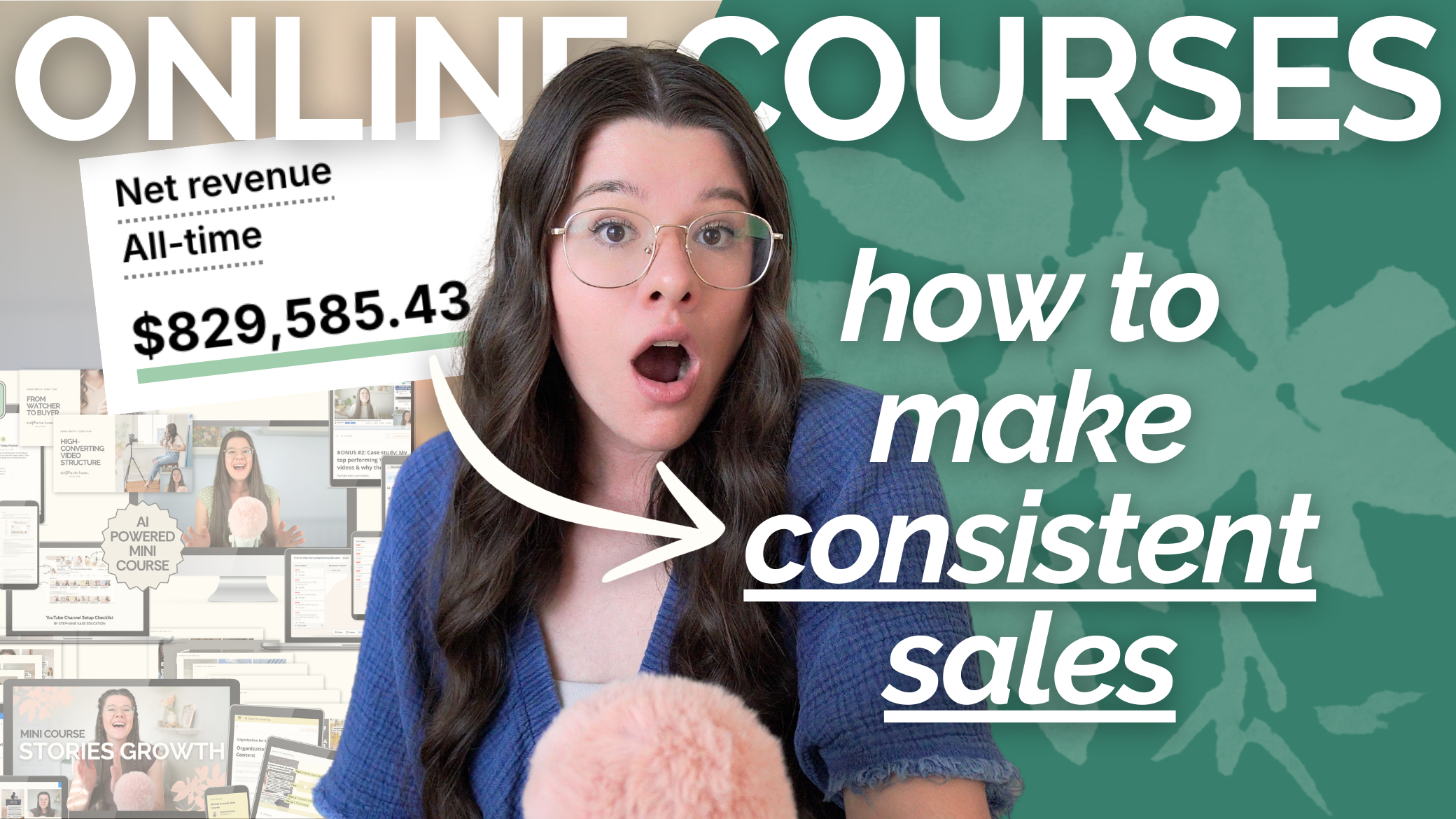

If you’ve ever wondered what it actually looks like to market online courses in a way that feels sustainable, simple, and profitable, I want to break it all down for you in this post. I’m sharing exactly what I’m doing right now in 2026 to market my digital products and courses, what has shifted in the online course space, and the three main marketing pillars that are driving sales in my business. And if you want to watch the full video version of this breakdown, it’s available right below.
LINKS MENTIONED:
- FREE YouTube Class
- FREE 10-Day Instagram Plan
- FREE Passive Income Guide
- Binge-Worthy Video Plan Course
- YouTube for Business Course
- YouTube Video: How You’re Going To Hit Your First $100k in Course Sales
- YouTube Video: The Shift With Online Courses No One Admits (What Really Works in 2026)
The Biggest Shifts I’m Seeing in Online Course Marketing Right Now
Before I walk through my exact strategy, I think it’s important to start with a couple shifts I’m seeing in the online course industry because these are shaping everything I’m doing right now. If you sell digital products, low ticket offers, or online courses, these shifts matter a lot.
The first big shift is that the industry has moved away from relying on just one signature course. More and more, I’m seeing the power of building out low ticket courses and digital products that allow people to choose what they need. Instead of expecting everyone to buy one big flagship offer, people want options. They want to be able to come into your world at a lower price point, solve one specific problem, and then keep going deeper with you if they want to.
The second shift is that people want to buy when they are ready. They don’t always want to wait for a big launch, a webinar, or a limited enrollment period to finally access your offer. And honestly, I’ve seen this play out in my own business in a really big way. More than ever, I’m focused on making it easy for someone to go from finding me to purchasing from me without jumping through a million hoops. If they’re ready, I want them to have a clear path to buy.
That shift alone has changed a lot of how I think about funnels, launches, and content. Instead of hiding everything behind complexity, I’m trying to make the path to purchase much more direct.
My Organic Content Strategy: YouTube and Instagram
The first major pillar of my marketing right now is organic content. This is still such a huge part of my business, and honestly, it makes everything else work better too.
For long-form content, YouTube is still the foundation of my evergreen content strategy. I aim to post one long form YouTube video each week, and even though I’ll be honest and say I’ve been a little behind on that so far this year, I’m actively getting ahead on content again. YouTube is the platform that continues to bring in new people over and over again, even when I’m not actively showing up every day. That matters so much to me as a business owner and as a mom.
What I love most about YouTube marketing is that it keeps working for you. A video I filmed months ago or even years ago can still bring in new leads, new subscribers, and new customers. That’s why I see it as one of the most sustainable content marketing strategies for online business owners. It is searchable, evergreen, and it gives your content a much longer shelf life than most other platforms.
On top of that, my YouTube videos are also the starting point for repurposing content. Every week, we turn them into blog posts, podcast episodes, email content, and sometimes even Instagram content too. So instead of creating from scratch all the time, I’m really trying to make one strong piece of long form content work harder for the business.
If YouTube is something you want to learn more about, I do have a Free YouTube Class that walks through how I use YouTube to market my business in a simple and sustainable way.
Then there’s Instagram, which is the second part of my organic content strategy. Instagram serves a very different purpose for me than YouTube. I think of Instagram as my short form content platform and also the place where I connect more deeply with my hottest leads.
This is especially true now that I’m running Meta ads. A lot of people find me through an ad and then immediately go look at my Instagram to see what I’m about. They’re snooping, which is honestly normal. So I want my Instagram to feel active, helpful, and aligned with what I’m teaching.
Right now, I’m posting on my Instagram feed around five days a week and showing up in stories almost daily. I use Instagram to share value, point people toward freebies, nurture trust, and stay top of mind with people who are already in my world. It’s also still a really helpful place for referrals and warm traffic.
And if you want help with what to post there, I also have a free 10 Day Instagram Plan that maps out exactly what to share based on what’s working right now.
Why I’m Not Using Ads to Grow My Email List
One thing that might surprise you is that I’m not currently running ads to grow my email list. My list is growing organically, mostly through YouTube and Instagram, and right now that growth is usually at least 500 new subscribers each month.
I’ve found that the people who come in organically are often the highest quality leads because they’ve already had more time to get to know me. They didn’t just see one random ad and opt into a freebie. They’ve usually watched my content, connected with my style, and built some trust first.
That doesn’t mean I’m against lead generation ads forever, but right now, I’m much more interested in growing my audience of buyers than just growing my audience of freebie seekers.
That mindset shift has changed everything.
My Meta Ads Strategy: Selling Low Ticket Offers First
The second major pillar of my marketing right now is Meta ads. This has been a newer focus for me, but it has become such a powerful part of how I’m growing my online course business.
Last October, I made the decision that I was done putting ads off. I knew that if I wanted to go all in on low ticket digital products and scale that side of my business, I needed to start learning how to use paid traffic in a smart way. And the strategy I’m using right now is very simple: I run ads directly to a low ticket paid offer.
Instead of sending ad traffic to a freebie and hoping it converts later, I’m sending people straight to a paid product. For me, one of my main offers has been Binge-Worthy Video Plan, which is a mini course and planning resource that helps business owners create their first five or next five YouTube videos in a more strategic, conversion-focused way.
The goal with these ads is not to throw thousands of dollars into the void and hope I make it back six months later. I’m running my ads in a way where they are generally paying for themselves. And recently, they’ve actually started becoming profitable, which has been really exciting to see.
That means when I spend money on ads, I’m usually making that money back pretty quickly. And even if I’m only breaking even on the front end, I’m still bringing in buyers. That matters so much because buyers are more likely to buy from you again.
That has probably been one of the most interesting things to watch. The low ticket product is not just making money on its own. It’s also feeding everything else in the business.
I recently launched my larger YouTube course, YouTube for Business, and over half of the buyers in that launch had purchased my low ticket product first. That’s a huge deal. It confirmed for me that building an audience of buyers is often way more powerful than just building a list of leads.
I also tested lead generation campaigns and spent money growing my email list through ads, and those leads did not convert nearly as well during the launch. That was really eye-opening for me.
So right now, I see Meta ads as another platform. They’re not replacing organic content. They’re amplifying it.
Why Email Marketing Is Still My Most Important Platform
The third major pillar of my marketing strategy is email marketing, and I really can’t overstate how important this has been for my business.
If everything else disappeared tomorrow — Instagram, YouTube, even my ads — my email list would still be one of the most valuable things I have. It is the platform I own. It is the platform that has sustained my business through seasons where I’ve needed to step back. And it is still one of the most direct ways I make sales.
This is why I always tell business owners to start their email list early. Even if you’re very new, even if you don’t have a huge audience, and even if your list feels tiny, start it anyway. It matters.
Right now, I’m sending around three email newsletters a week when I’m not actively in a launch or promotion. That is definitely more than I used to send. For a long time, I was sending one, maybe two emails a week. But last fall, I decided to test what would happen if I simply showed up more often.
And honestly, it has been such a positive shift.
Because of the industry shift I mentioned earlier — people wanting more opportunities to buy when they’re ready — sending more emails has just made sense. It gives me more opportunities to nurture my audience, share value, and naturally point people toward the right offers.
That doesn’t mean every email is a sales email. Not at all. But it does mean I’m not hiding my offers anymore or waiting for one giant launch every few months to finally talk about them.
What My Marketing Rhythm Looks Like Right Now
If you’re wondering what this actually looks like in a normal month, here’s the basic rhythm I’m aiming for right now.
I try to publish one YouTube video each week, post to Instagram around five days a week, and show up in stories almost daily. With ads, I’m usually launching one to two new campaigns or ad creatives each week to keep things fresh and continue testing what works.
And on the email side, I’m sending three newsletters a week, plus I’m usually running at least one promotion each month. Sometimes that looks like a flash sale, a limited-time bonus, or a simple promotion around one specific offer. It does not always mean a giant launch.
That has honestly been one of the most freeing shifts in my business. I no longer feel like every sale has to be a huge event. Sometimes it’s just giving people a really clear opportunity to buy something that helps them.
And that has been so much more sustainable.
The Marketing Strategy That’s Working Best for Me in 2026
If I had to sum up my online course marketing strategy right now, it would be this: I’m building a business that gives people more opportunities to find me, trust me, and buy from me in a way that feels simple and aligned.
That means organic content is still incredibly important. It means paid ads are helping me scale by bringing in more buyers. And it means email marketing is the glue holding all of it together.
I’m not relying on one giant launch or one viral post to carry the whole business. I’m building a system that works together and keeps working even when life gets busy, which matters so much to me.
And if you’re trying to build more recurring, sustainable sales in your own business, this is exactly the kind of shift I’d encourage you to think about too.
If you want help creating more consistent, sustainable revenue from your content and offers, make sure to grab my Free Passive Income Guide. It will walk you through how to build income streams in your business that don’t rely on you constantly launching, posting, or showing up in real time.
I’m cheering for you, and I hope this gave you a really honest look at what online course marketing looks like for me right now in 2026.