




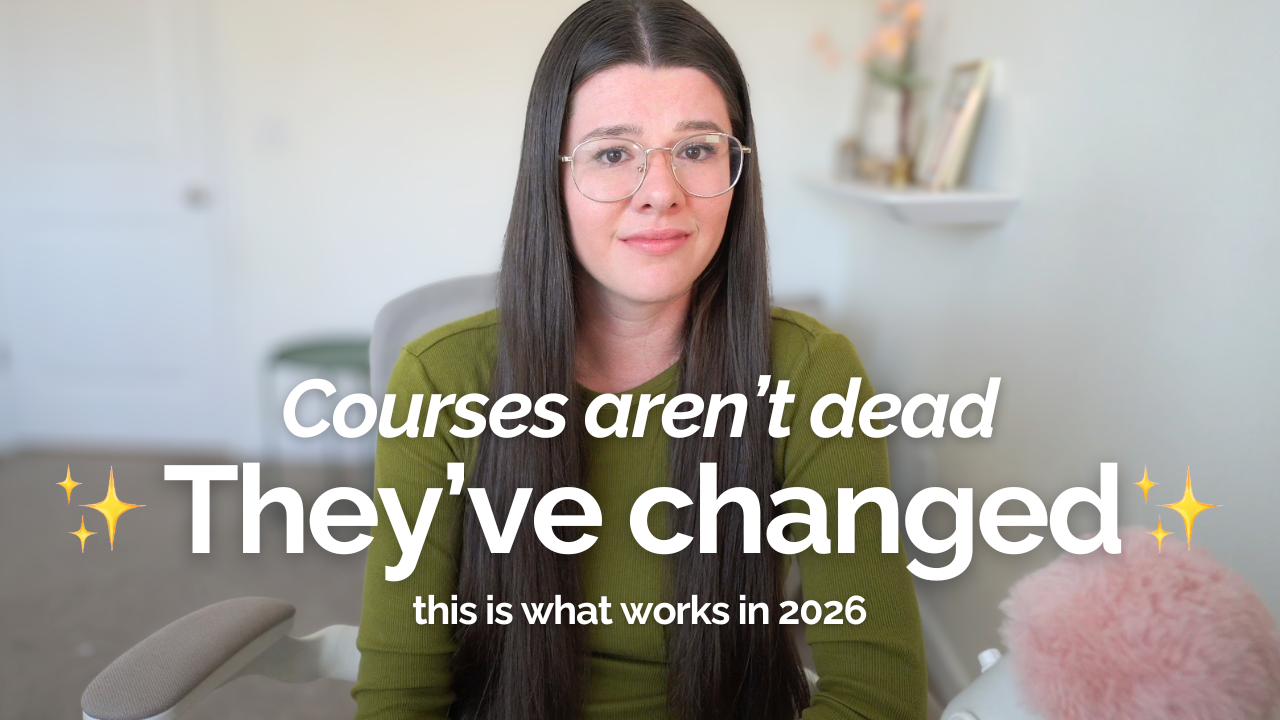

The online course industry has changed a lot over the past few years, and if you’ve been thinking about creating or selling a course, you’ve probably felt that shift. In this post, we’re breaking down what’s really happening right now, why people say “courses are dead” (they’re not), and what you should be doing differently if you want your course to actually sell. You can watch the full video below for a deeper dive into this shift and how to adapt your strategy moving forward.
LINKS MENTIONED:
- FREE download, Type of Course People Will *Actually* Buy
- YouTube Video: Create an Online Course That People Actually Want to Buy
Are Online Courses Dead? Not Even Close
Let’s address this upfront, because it’s something you’ve probably heard before. People love to say that online courses are dead, but that’s simply not true. What they really mean is that their old way of selling courses isn’t working anymore.
The industry has evolved, just like any other space online. What worked five or ten years ago doesn’t necessarily work today, and that’s where a lot of people get stuck. Instead of adapting, they assume the entire model is broken.
But here’s the reality. Online courses are still one of the most powerful ways to scale your knowledge and build an online business. There are creators generating consistent income, building flexible schedules, and serving their audience in a meaningful way through courses right now. The difference is that they’ve adjusted to how buyers behave today.
And that shift is what we need to talk about.
The Biggest Shift: From “Everything Courses” to Specific Solutions
One of the biggest changes in the online course space is how content is packaged. In the past, it was common to create one massive course that included everything you knew about a topic. Think hundreds of lessons, tons of modules, templates, bonuses – all bundled into a $500 or $1,000 offer.
That approach doesn’t land the same way anymore.
Today, people want specific solutions to specific problems. They’re not looking for a deep dive into everything. They’re looking for the exact thing that will help them get a result quickly.
So instead of creating one big course on a broad topic, the shift is toward breaking that content into smaller, hyper-specific courses. For example, instead of one full YouTube course, you might have separate offers for video ideas, filming, editing, and gear setup.
This gives your audience the ability to choose exactly what they need, instead of paying for content they may never use. It also makes your offer feel more approachable and easier to say yes to.
And honestly, it aligns better with how people consume information today. There’s already so much content online. People don’t want more noise. They want clarity.
Why Simplicity and Speed Matter More Than Ever
Another important shift is how people value speed and simplicity. It’s no longer about how much you can include in your course. It’s about how quickly you can help someone achieve a result.
More content does not equal more value.
In fact, too much content can actually overwhelm your students and slow them down. When someone buys a course, they’re not thinking, “I hope this takes me 20 hours to complete.” They’re thinking, “I want to solve this problem as fast as possible.”
So the goal now is to strip your course down to exactly what’s needed to get that result. Nothing more, nothing less.
Then, instead of bundling everything together, you can offer additional resources as optional add-ons. This could look like templates, tools, or even AI support that helps them implement faster. The key is giving your audience the choice.
Some people want the basics. Others are willing to invest more to speed up the process. Both should be able to buy from you in a way that fits their needs.
The Rise of Low-Ticket Entry Points
Another noticeable shift is in pricing strategy. With growing skepticism in the online space, people are more hesitant to invest large amounts upfront.
There’s been a lot of broken trust in the industry. Many people have purchased courses that didn’t deliver on their promises, and that has changed buyer behavior.
Because of that, low-ticket offers are becoming more powerful than ever. A lower-priced, highly specific course gives your audience a chance to experience your teaching style and see results without a huge commitment.
Once they trust you, they’re much more likely to buy from you again.
This is where a well-structured offer suite comes into play. Instead of relying on one high-ticket course, you create an ecosystem of offers. Someone might start with a course under $100, then choose to add on more advanced topics or resources over time.
It creates a natural progression, and it builds trust at every step.
Trust Is the New Currency
If there’s one thing driving all of these changes, it’s trust.
People are more discerning now. They’re paying attention to whether creators actually deliver on what they promise. They’re looking for authenticity, consistency, and real results.
This means your marketing and your course content need to align. You can’t overpromise and underdeliver anymore. That approach might have worked in the past, but it doesn’t hold up today.
Building trust looks like showing up consistently, being honest about what your course will and won’t do, and genuinely helping your audience get results. It also means creating offers that feel aligned with where your brand is going.
There’s a long-term play here. When someone trusts you, they don’t just buy once. They continue to come back.
Your Course Is a Living, Breathing Offer
Another shift that’s important to understand is how we think about courses themselves.
Courses are no longer something you create once and sell forever without touching again. That “passive income” mindset is outdated.
Your course is a living, breathing offer. It needs to evolve as your industry changes.
That means updating your content regularly, refining your lessons, and making sure everything stays relevant. At a minimum, reviewing your course once a year is a good standard.
In some cases, it might even mean retiring a course altogether if it no longer aligns with your brand or if you can’t confidently stand behind it.
That decision might feel difficult, especially if it’s generating income, but it builds long-term trust with your audience. And that trust is far more valuable than short-term sales.
What This Means for You Moving Forward
If you’re thinking about creating an online course – or if you already have one – this shift is actually a huge opportunity.
You don’t need to create a massive, all-in-one program. You don’t need to overwhelm your audience with content. And you definitely don’t need to rely on outdated strategies that no longer resonate.
Instead, focus on solving one specific problem really well. Make it simple. Make it actionable. Help people get results quickly.
From there, you can build out additional offers that support your audience at different stages. You’re not just selling a course. You’re creating a pathway for someone to grow with you.
And when you approach it that way, courses aren’t just “alive” – they’re one of the most effective tools you have in your business today.
Ready to Create a Course That Actually Sells?
If you want to go deeper into what to include in your course and how to structure it in a way that gets results, here’s a free download that walks you through exactly that. It breaks down what makes a course valuable today and how to build something your audience will actually want to buy.
You can also check out the full video above for more context and examples of how this shift is playing out in real time.